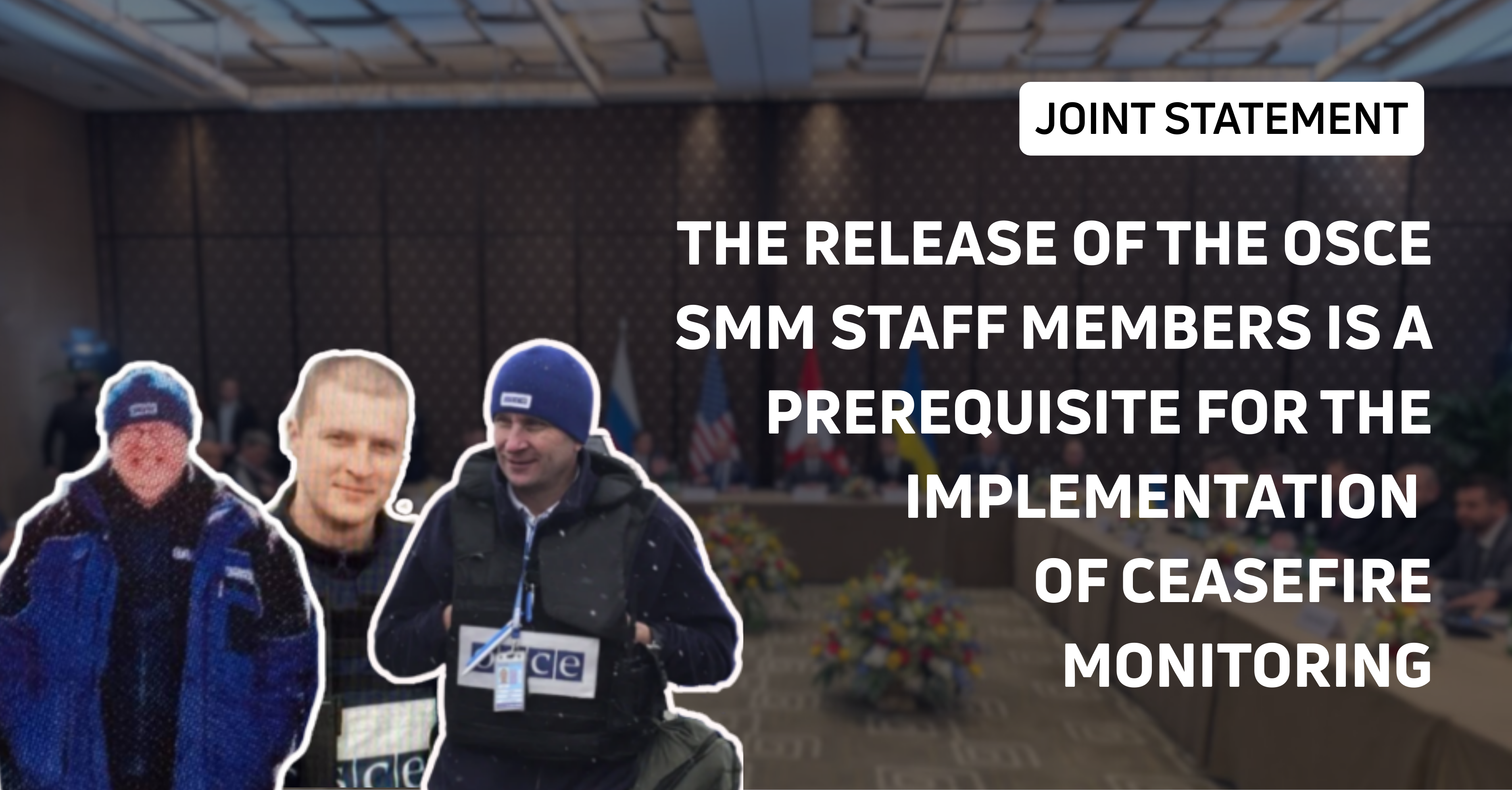
The OSCE Special Monitoring Mission (SMM) to Ukraine was deployed in 2014 as a civilian, unarmed mission mandated by all OSCE participating States, including the Russian Federation. Its staff documented the security situation, recorded ceasefire violations, facilitated dialogue and prepared reports for the international community. They operated publicly and in accordance with international law.
In 2022, three staff members of the OSCE SMM – Dmytro Shabanov, Maksym Petrov and Vadym Golda – were detained in the temporarily occupied territories of the Luhansk and Donetsk regions, despite their international immunity and security guarantees. After being held in detention without proper access to legal assistance and communication with their families, and without being guaranteed the right to a fair trial, they were convicted on fabricated charges of “espionage” and “high treason”: Shabanov and Petrov were sentenced to 13 years’ imprisonment with subsequent deportation to the Russian Federation, and Golda was sentenced to 14 years in a strict regime penal colony.
The continued detention and persecution of international mission staff in connection with the performance of their direct duties undermines the very idea of ceasefire monitoring. Without real guarantees of security and respect for the immunities of international monitors, any mechanism becomes vulnerable to pressure, intimidation and selective access. This makes comprehensive verification of violations impossible, creates space for manipulation, and deprives the parties and the international community of a reliable instrument for deterrence and de-escalation.
The issue of introducing monitoring of a possible ceasefire in the context of Russia’s war against Ukraine is increasingly being discussed at the highest political level. As early as 2026, the OSCE announced its readiness to participate in monitoring during the visit of the Swiss Foreign Minister and the OSCE Secretary General to Kyiv and Moscow. Statements and comments by representatives of Ukraine and the Coalition of the Willing mentioned the intention to introduce monitoring with the active participation and/or leading role of the United States.
However, when agreeing on a new presence, the international community must answer the question: can it guarantee the safety of those it deploys to the conflict zone if the staff members of the previous mission remain in unlawful detention?
Russia uses monitors for political purposes, subjects them to torture and inhuman treatment, exerts pressure on them and denies them adequate conditions of detention. In 2025 alone, Shabanov and Petrov were transferred from a penal colony in the Luhansk region to remote regions of Russia – Omsk and Chelyabinsk, respectively. This happened after last year’s visit by the OSCE Secretary General to the Russian Federation – Shabanov was transferred the same month, in March.
Even the very intensification of negotiations on the design of ceasefire monitoring increases the risk of instrumentalisation and deterioration of the situation of OSCE staff on the part of Russia.
The release of Shabanov, Petrov and Golda is a necessary precondition and a test of the real possibility of agreeing and implementing ceasefire monitoring, and the Russian Federation’s willingness to respect this regime. It is also a moral obligation of the countries on which the lives and safety of OSCE staff and potential monitors of the future mechanism already depend.
We call upon Ukraine, the United States, the countries participating in the Coalition of the Willing, the participating States of the OSCE, Switzerland as the chairing country, and the OSCE Secretary General to:
We call upon the Russian Federation to:
Signatory NGOs:
Human Rights Centre ZMINA, Ukraine
Ukrainian Legal Advisory Group, Ukraine
Austausch e.V. – For a European Civil Society, Germany
Center for Civil Liberties, Ukraine
Crimean Human Rights Group, Ukraine
Educational Human Rights House – Chernihiv, Ukraine
HRM “Bir Duino-Kyrgyzstan”, Kyrgyzstan
Norwegian Helsinki Committee, Norway
Helsinki Citizens’ Assembly Vanadzor, Armenia
Media Initiative for Human Rights, Ukraine
Helsinki Committee for Human Rights in Serbia
NGO “CRIMEA SOS”, Ukraine
NGO “Crimean Process”, Ukraine
Charitable Foundation “Principle of Hope”, Ukraine
Crude Accountability, USA
Kazakhstan International Bureau for Human Rights and Rule of Law, Kazakhstan
Public Association “Dignity”, Kazakhstan
Kharkiv Regional Foundation “Public Alternative”, Ukraine
Netherlands Helsinki Committee, the Netherlands
Truth Hounds, Ukraine
“Political Prisoners Support. Memorial” Human Rights Project
Human Rights Center “Viasna”, Belarus
Macedonian Helsinki Committee, North Macedonia
Freedom Files, Poland
Human Rights Center, Georgia
Lawyers’ Committee for Human Rights YUCOM, Serbia
NGO “Social Action Centre”, Ukraine
Individual signatures:
Kimberley Bulkley, Former OSCE SMM, USA
Tor Fredrik Moe, Norway
David Orrells, Former OSCE SMM Technical Monitoring Group Leader, UK
Grant Knoetze – Paramedic, OSCE SMM Ukraine, South Africa
Dmitri DATCO, former OSCE SMMU monitor, Moldova
Gabriela Steinle, former OSCE SMMU Monitoring Officer / Patrol Group Leader, Switzerland
Anton Yermakov, former OSCE SMMU Language / Administrative Assistant, Ukraine
Lena Stoltz, former OSCE SMMU Monitoring Officer, Sweden
Diana Cena, former OSCE SMM Monitoring Officer, Albania
Mark Pearsall, Former OSCE SMMU Patrol Group Leader, United Kingdom
Attila Kulcsár, former OSCE SMM Monitoring Officer, Hungary
Anonymous, Former OSCE SMMU Monitoring Officer, Serbia
Berit Lindeman, Secretary General, Norwegian Helsinki Committee, Norway
Mark Farrant, Former OSCE SMMU Operations Officer, United Kingdom
Johan Chytraeus, former Deputy Team Leader OSCE SMM, Sweden
Kristina Babić, Former OSCE SMMU/Media coordinator, Luhansk Monitoring Team, Croatia
Aleksandr Tigin, former OSCE SMMU Monitoring Officer, Russian Federation
Laura Jaffrey, former OSCE SMMU Monitoring Officer, Switzerland
Paul Fraleigh, former OSCE SMMU Monitoring Officer, Canada
Tinatin Bezhanishvili, Former OSCE SMMU Deputy Hub Leader, Deputy Hub Ops Coordinator, Patrol Group Leader, Georgia
Arve Hansen, Senior Adviser, Norwegian Helsinki Committee, Norway
Elisabet Thorp, former OSCE SMMU Monitoring Officer, Sweden
Yves Vervecken, Former OSCE SMMU Monitoring Officer, Belgium
Matthew Weaver, Former OSCE SMMU Monitoring Officer, United States
Alexandra Camberea, Former OSCE SMMU Monitoring Officer, Romania
Viktoriia Kish, former OSCE SMMU Language Assistant, Ukraine
Oleksii Bukalov, former OSCE SMMU Language / Security Assistant
Andrii Dalskyi, former OSCE SMMU Language Assistant, Ukraine
Alison Stables, Former OSCE SMMU Deputy Team Leader, United Kingdom
Oliver Palkowitsch, Former OSCE SMMU Monitoring Officer, Germany
Annett Gerber, Former OSCE SMMU Monitoring Officer LMT, Germany
Dora Chomiak, CEO Razom for Ukraine
Anna Lomakovska, former OSCE SMMU National Payroll Officer
Oksana Konstantinova, former OSCE SMMU Learning and Development Assistant, Ukraine
Volodymyr Herasymenko, former OSCE SMMU Transport Assistant Dnipro MT, Ukraine
Kristina Hook, Kennesaw State University
Adylbek Kurbanov, former OSCE SMMU Monitoring Officer, the Kyrgyz Republic
Zviadi Esebua, former OSCE SMMU Monitoring Officer, Georgia
Shane Ahn, OSCE SMMU Monitoring Officer, DPH & SPH, US
Simon Tiller, former OSCE SMMU Deputy Head of Reporting and Political Analysis Unit in Kyiv, United Kingdom
Alda Malko Jarmuzek, former OSCE SMMU Monitoring Officer LMT, Albania
Paul Grod, President, Ukrainian World Congress, Canada
Maxence Peniguet, former OSCE SMMU, Monitoring Officer LMT, France
Katarina Lavrinenko Friis-Olsen, affiliated with the Norwegian Centre for Human Rights, Norway
Nichita Gurcov, former OSCE SMMU, Monitoring/Reporting Officer DMT/HO, Moldova
Kristoffer Tønnesen, former OSCE SMMU Monitoring Officer, Norway
Jon Casey, former OSCE SMMU, Operations Officer – Luhansk MT and Kyiv Operations Center, United States
Daniele D’Esposito, former SMM monitoring officer in Severodonetsk, Switzerland.
Celia Alexander, former OSCE SMMU, Monitoring Officer LMT, United States
Fabrice TURCO, former OSCE SMMU, Monitoring Officer, France
Daria Varyvod, former OSCE SMMU, Language Assistant, Ukraine
Yvette Langenhuizen, former Deputy Team Leader, Luhansk/Severodonetsk MT, The Netherlands
Neil Brown, OSCE SMMU, Paramedic, South Africa
Maddalena Dalla Mora, former OSCE SMMU Monitoring Officer, Luhansk MT, Italy
Rafal Jarmuzek, former Cherson Team Leader, Poland
Viara Valtchanova, former OSCE SMMU Senior Political Analyst, United Kingdom
Józef Lang, former OSCE SMMU Trend Analysis Coordinator, Poland
Anonymous, former OSCE SMMU, 2018-2022
Antoni Miś, former OSCE SMM Planning and Coordination Officer, Poland
Jemal Gogitidze, former OSCE SMMU Information Analysis Officer, Georgi
Anne Maufrais, formerly SMMU
Basia Dziekońska, SMMU – Monitor Luhansk.
Zoran Mitrevski, Former SMMU member
Ivan Milicevic, Former OSCE SMM staff member
Izet Mahir, Organisation for Security and Co-operation in Europe (OSCE), Special Monitoring Mission to Ukraine
Alastair Lithgow, Paramedic, OSCE SMM Ukraine
Farrukhsho Dzhunaydov, former OSCE SMMU Monitoring Officer, Tajikistan
Borys Babin, Association of Reintegration of Crimea
Gerard Boink, Former OSCE/SMM staff member
Lirim, OSCE SMMU- Luhansk MT
Duncan Spinner, Formerly Head of Operations SMM Luhansk
Read next
Articles
The voices of Ukrainians must be heard
The letter was published in May 2026 on the website of our long-time partner ECCHR, in the Living Open Archive section. It is a collection of personal impressions and stories from ECCHR staff and partners about the projects they work on, the injustices and contexts they experience, and the world they envision. They share intimate reflections in letters to their colleagues, allies, and the world.
Articles
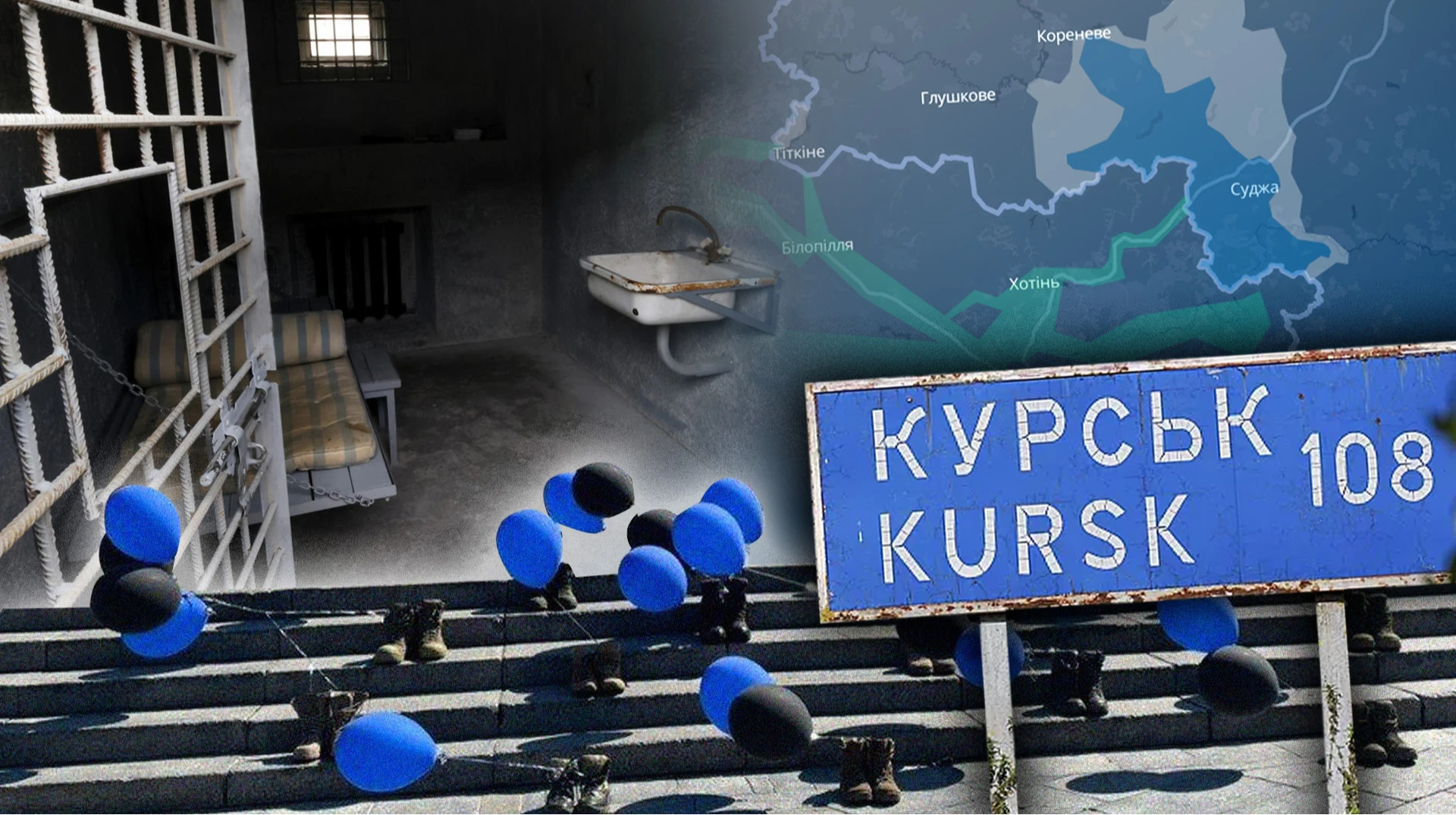
Prisoners of War Tried as Terrorists: What Is Happening to Ukrainian Soldiers Captured in Russia’s Kursk Region
The number of Ukrainians captured by Russian forces in the Kursk region remains hidden by the fog of war and defenders may be considered missing in action for months before suddenly appearing in photographs posted on Telegram channels alongside other prisoners of war. Or, conversely, families may search those same channels every day for any trace of their loved one, only to one day receive the devastating news of their death.
Articles
ECtHR Case Law on the Consequences of the Armed Conflict in Ukraine: The Detention of Ukrainian Troops at the Chornobyl Nuclear Power Plant
At the start of Russia’s full-scale invasion, one of the primary objectives of the Russian armed forces was to seize control of the Chornobyl Nuclear Power Plant (ChNPP). In February 2022, Russian troops occupied the facility and detained everyone there, including both civilian personnel responsible for maintaining the operation of the plant and members of the National Guard of Ukraine (NGU), who were responsible for the facility’s security.