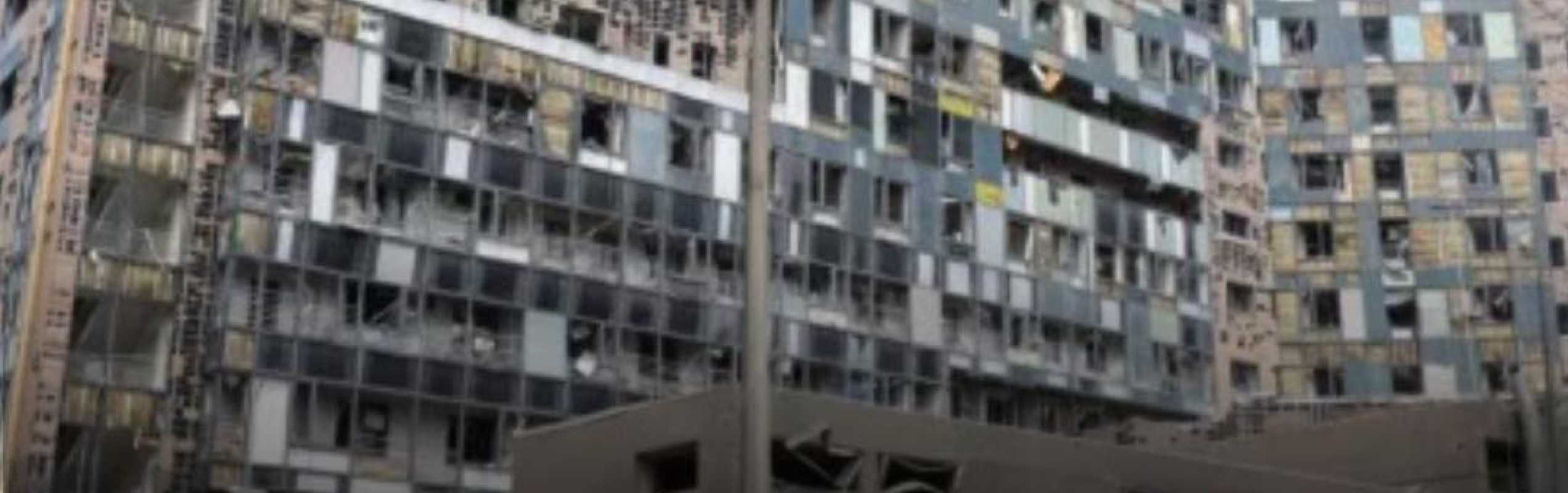
On the morning of July 8, the Russian Federation launched a series of missile attacks on civilian infrastructure in Ukraine. Kyiv, Dnipro, Kryvyi Rih, Sloviansk, and Kramatorsk were under attack. Around 40 missiles of various types were fired at the territory of Ukraine, some of which hit residential buildings, civilian infrastructure and children’s hospitals.
According to the SES of Ukraine, in Kyiv, as of 19:00, 22 people were killed and 74 others were injured. In total, 33 people have been killed and 140 others injured in Ukraine as a result of the hostile attack. Unfortunately, the number of victims may increase.
One of the facilities targeted by the Russian army was the Okhmatdyt Children’s Hospital in Kyiv. Investigators of the Security Service of Ukraine claim that the attack was carried out with an X-101 missile.
Okhmatdyt is a multidisciplinary diagnostic and treatment facility in Kyiv that provides specialised, highly qualified medical care to the child population of Ukraine. It is the largest specialised children’s hospital in Ukraine and one of the most important not only in Ukraine but also in Europe. About nine thousand surgeries are performed here every year. Since the first days of the large-scale invasion, the hospital’s buildings have become a temporary home for patients and staff.
As a result of the Russian strike, the facility was heavily damaged. People are trapped under the rubble, and the exact number of injured and dead is still being determined. At least two medical staff members of the facility were killed. Rescue operations are ongoing.
Also in the afternoon, a missile strike damaged the ISIDA obstetric and gynaecological clinic, which specialises in infertility treatment, obstetrics, gynaecology, mammalogy and paediatrics. So far, seven people have been reported dead and three injured. The building is partially destroyed, dismantling of the rubble and search for people is ongoing.
Attacks on medical infrastructure facilities are a typical technique of the Russian army, which was regularly used during the wars in Chechnya and Syria. This is no exception to the armed aggression against Ukraine. Over the two years of the full-scale war, Russia has damaged or destroyed 1,736 medical facilities in Ukraine. One of the most famous tragic examples of the destruction of a medical facility in Ukraine after the start of large-scale armed aggression was the strike on a maternity hospital in Mariupol on March 9 2022: at least 39 people were injured or killed.
Today, the presidents of Poland, the Czech Republic, Moldova, and the prime ministers of the United Kingdom and Estonia have already condemned the Russian Federation’s attack on children’s hospitals. In turn, Ukraine is initiating the convening of an extraordinary meeting of the UN Security Council, which is currently chaired by Russia. The Security Service of Ukraine opened a criminal investigation, classifying the strikes on hospitals as a violation of the laws and customs of war.
However, international condemnation and the convening of meetings of any treaty bodies are clearly not enough to stop the destruction of civilian infrastructure, including medical facilities in Ukraine, and to ensure that those responsible for these attacks are brought to justice.
Therefore, we call on the international community:
– to intensify efforts to provide Ukraine with effective air defence systems in sufficient numbers and other military support in a timely manner to effectively defend itself against Russian attacks and to ensure that Ukraine exercises its right to self-defence in accordance with Article 51 of the UN Charter;
– to introduce more effective sectoral sanctions against various sectors of the Russian economy that provide the financial basis for the aggressive war against Ukraine;
– to impose sanctions against those economic entities from around the world that allow the aggressor state to circumvent existing sanctions.
We appeal to the International Criminal Court not to limit the timeframe of the investigation into the attacks on critical infrastructure to March 9 2023, as today’s brutal attack shows that the Russian Federation continues to target critical infrastructure; given the recent personnel changes in the Russian military leadership, we also emphasise the need for new arrest warrants, not only for the military command, but also for the senior political leaders of the Russian Federation.
We call on international organisations, in particular the UN Commission of Inquiry, to properly document today’s attack on civilian objects, including the children’s hospitals Okhmatdyt and ISIDA.
We call on the international community, in particular the members of the Core Group, to establish an accountability mechanism with a mandate to hold all perpetrators of today’s most serious international crimes, including crimes of aggression, war crimes and crimes against humanity, to strengthen the capacity of national law enforcement systems to deliver genuine and effective justice.
We call on the government of Ukraine to improve national legislation as a matter of priority to ensure a high-quality investigation into the actions of the military and political leadership of the Russian Federation that led to this latest tragedy. We firmly believe that it is urgent to ratify the Rome Statute of the International Criminal Court – a treaty that would lay the foundation to ensure accountability for war crimes.
Read next
Articles
The voices of Ukrainians must be heard
The letter was published in May 2026 on the website of our long-time partner ECCHR, in the Living Open Archive section. It is a collection of personal impressions and stories from ECCHR staff and partners about the projects they work on, the injustices and contexts they experience, and the world they envision. They share intimate reflections in letters to their colleagues, allies, and the world.
Articles
Prisoners of War Tried as Terrorists: What Is Happening to Ukrainian Soldiers Captured in Russia’s Kursk Region
The number of Ukrainians captured by Russian forces in the Kursk region remains hidden by the fog of war and defenders may be considered missing in action for months before suddenly appearing in photographs posted on Telegram channels alongside other prisoners of war. Or, conversely, families may search those same channels every day for any trace of their loved one, only to one day receive the devastating news of their death.
Articles
ECtHR Case Law on the Consequences of the Armed Conflict in Ukraine: The Detention of Ukrainian Troops at the Chornobyl Nuclear Power Plant
At the start of Russia’s full-scale invasion, one of the primary objectives of the Russian armed forces was to seize control of the Chornobyl Nuclear Power Plant (ChNPP). In February 2022, Russian troops occupied the facility and detained everyone there, including both civilian personnel responsible for maintaining the operation of the plant and members of the National Guard of Ukraine (NGU), who were responsible for the facility’s security.