By Rustem Khalilov, originally published on Ukrainska Pravda (in Ukrainian)
Early August marks two years since Ukrainians proved that Russian territory is not untouchable. On 6 August 2024, Ukraine’s Defense Forces launched an offensive in Russia’s Kursk region and, by the end of the month, had taken control of more than 100 settlements, covering approximately 1,300 square kilometres.
However, they captured not only territory but also enemy personnel. For example, on 14 August 2024, the largest single capture of Russian troops took place when troops from the Security Service of Ukraine’s Special Operations Center “A” took 102 servicemen of the Russian Armed Forces’ 488th Guards Motor Rifle Regiment and the Akhmat special unit prisoner.
On Ukraine’s Independence Day, the first prisoner exchange took place. Ukraine returned Russian conscripts captured in the Kursk region and secured the release of 115 Ukrainian servicemen, most of whom had defended Mariupol.
During the Kursk operation, Ukraine added 1,018 Russian servicemen to its exchange pool. This figure was cited by former Commander-in-Chief of the Armed Forces of Ukraine Oleksandr Syrskyi.
Yet prisoners were taken on both sides.
Not all Ukrainian soldiers survived long enough to reach places of detention. In October 2024, for instance, the DeepState project, citing sources in the 1st Separate Tank Brigade, reported that Russian forces executed nine Ukrainian servicemen who had surrendered in the Kursk region.
According to Ukraine’s Unified Register of Pre-Trial Investigations, 127 criminal proceedings have been opened because of the killings of 321 prisoners of war, the Office of the Prosecutor General told “Ukrainska Pravda”. Earlier, the Office stated that at least 75 Ukrainian servicemen had been executed after surrendering during the Kursk operation — nearly one in four of all documented executions of Ukrainian POWs.
The number of Ukrainians captured by Russian forces in the Kursk region remains hidden by the fog of war and defenders may be considered missing in action for months before suddenly appearing in photographs posted on Telegram channels alongside other prisoners of war. Or, conversely, families may search those same channels every day for any trace of their loved one, only to one day receive the devastating news of their death.
Human rights defenders possess verified information only about those servicemen whom Russia itself has brought out of that fog by initiating criminal proceedings against them. According to Tetiana Katrychenko, head of the Media Initiative for Human Rights, there are currently 404 confirmed cases of this kind.
What happened to the Ukrainian soldiers captured on Russian territory, and how their situation differs from that of most other prisoners of war, is the subject of this article.
Collage by Andrii Kolistratenko, Ukrainska Pravda
For Oksana, a resident of Ukraine’s Cherkasy region, the Russian language has become a trigger.
“It has been sitting right here for almost two years,” she says, placing her hand on her chest. “The moment I hear Russian, something inside me just switches.”
It all began with a video of her son, Mykola, which she found on a Telegram channel. In the footage, he answered questions in Russian while, just behind his head, the barrel of an assault rifle was clearly visible. His mother immediately sensed how forced and unnatural his words were. Mykola had never spoken Russian, had not studied it at school, and in the recording it even seemed as though he did not know how to pronounce some words correctly.
Both names in this story have been changed. The people and the events, however, are real. Because when your son is held in Russian captivity, one of a mother’s foremost principles is simple: do no harm. And no one knows what might worsen his situation—perhaps even allowing journalists to publish his real name or hers.
“Stubborn,” Oksana says when describing her son. Kind, brave, compassionate — and stubborn. When Russia launched its full-scale invasion, he insisted on joining the military despite suffering from a stomach ulcer.
“Mom, I’m going to defend my country. Dad is already getting old, but I still can.”
Mykola was deployed to the Kursk direction in early September 2024. Just a few days later, his unit was assigned the mission that would prove fatal: he and his comrades were captured.
Oksana did not learn of her son’s capture from his military unit or the Territorial Centre for Recruitment and Social Support. Instead, she found out through that very video. One of her relatives, who also serves in the military, came across it online.
The official notification from the Territorial Centre arrived two days later. It stated that Mykola had been captured in Ukraine’s Sumy region. Oksana could not understand why it said Sumy, since there had been no fighting there at the time and her son had been participating in the Kursk operation.
From that moment on, monitoring Telegram channels reporting on the dead and the captured became part of her daily routine. Oksana left her contact details and information about her son wherever she could.
Five months later, she received the first news from an unknown phone number. A young man she had never met told her that he had been held in the same penal colony as Mykola.
“I wanted to thank you for your son. He knows how to support people. He’s such a kind person.”
“As a mother, I immediately asked him, ‘Please tell me what happened there. How were you treated?’ He said, ‘We worked. We were given quotas to meet. If we met them, we got an extra piece of bread or a cigarette. If we didn’t… I’d rather not tell you,’” Oksana recalls.
A month later, she saw another video on a Telegram channel — this time from a Russian courtroom. Four Ukrainian servicemen were sitting in the defendants’ dock. One of them was her son.
The men were accused of terrorism and murdering civilians. According to the charges, they had shelled civilian buses. Oksana immediately noticed that on the dates mentioned in the indictment, her son had not yet even arrived in the Kursk region.
“It was horrifying. He had lost so much weight. Even his voice no longer sounded like his own. It hurts so much. It hurts me, and I think about all the mothers, sisters, and wives who watch these videos, who wait, search, and keep hoping.”
Each of the four servicemen was sentenced by a Russian court to 17 years’ imprisonment. Under the sentence, they are to serve the first four years in a prison before being transferred to a penal colony.
“When you speak to the families of those who took part in the Kursk operation, the pattern is always the same: the serviceman stops responding, and for weeks or even months — there is no information about him. Sometimes he appears in a video posted on Telegram. Then, sooner or later, the Russian Investigative Committee announces that the person has been convicted — usually sentenced to 14, 15, or 16 years,” says Tetiana Katrychenko.
The reason is that Russia does not recognise hostilities on its own territory as part of an international armed conflict. And because of that, Ukrainian soldiers captured in the Kursk region are charged with illegally crossing the state border and committing acts of terrorism.
This approach was personally endorsed by Vladimir Putin. Speaking at an expanded meeting of the Prosecutor General’s Office in March 2025, he declared:
“All servicemen of the Ukrainian army, and especially foreign mercenaries, who were present on our territory and committed a number of crimes against the civilian population must be, and are being, classified under our law as terrorists.”
According to Katrychenko, Russian investigators routinely supplement terrorism charges with additional criminal offenses. Under the severe torture routinely inflicted on prisoners — torture that can leave them permanently disabled or even result in death — captives have virtually no choice but to sign whatever investigators place before them.
“The Insider” calculated that, in Russia, terrorism cases typically take between 12 and 18 months from the filing of charges to referral to court. For Ukrainian prisoners captured in the Kursk region, however, the process takes an average of just five and a half months.
Katrychenko describes how this conviction machine operates. Initially, the so-called “Kursk prisoners” are held together and isolated from other detainees. The detention facility most frequently mentioned by former prisoners is the pre-trial detention center in Stary Oskol, Belgorod region.
Their trials are conducted swiftly via video link. Most cases are heard by the Second Western District Military Court, which has jurisdiction over the Kursk region. The court handed down its first convictions of Ukrainian servicemen in December 2024, sentencing two soldiers. By comparison, in April 2025 alone, 58 prisoners received sentences.
The entire proceeding — including the announcement of the verdict — usually lasts between forty minutes and one hour. Under such circumstances, it is impossible to speak of any meaningful legal defense.
Those sentenced must serve the first years of their lengthy prison terms in a closed prison, where conditions are significantly harsher than in a penal colony.
As Ukrainska Pravda previously reported, many of the “Kursk prisoners” are transferred to the prison in Verkhneuralsk, Chelyabinsk region. Very little is known about what happens to Ukrainian servicemen behind its walls.
“Russia generally hides everyone — both prisoners of war and civilians but it singles out the Kursk prisoners even through its own actions. They were captured on Russian territory; the trials are, first, conducted on a massive scale and, second, extremely quickly and behind closed doors. No one, not even lawyers, has any real access. Later they simply reappear in prisons that are equally inaccessible,” Katrychenko explains.
“The criminal prosecution of Ukrainian combatants solely for participating in hostilities constitutes a violation of international humanitarian law.” This conclusion appears in the interim report of the OSCE Office for Democratic Institutions and Human Rights on the situation in Ukraine, published in December last year.
From the perspective of international law, it makes no difference whether a Ukrainian serviceman is captured on Ukrainian or Russian territory, explains Alina Pavliuk, an analyst at the Ukrainian Legal Advisory Group. Combatants enjoy immunity that protects them from criminal prosecution merely for taking part in hostilities.
If they are suspected of specific crimes for example, crimes committed against civilians — that is a different matter, and the detaining state may investigate. Even then, however, they remain entitled to a fair trial.
“A terrorist act is a very specific criminal offense that is not characteristic of armed conflict as such. It requires proof of specific intent, for example, the intention to coerce a state or government into taking certain actions. It also requires demonstrating the existence of a terrorist organisation carrying out terrorist acts,” Pavliuk adds.
This helps explain why Ukraine does not prosecute Russian prisoners of war under terrorism charges simply for participating in hostilities. That said, there have been exceptions. One example is the case of Russian GRU officers Captain Yevgeny Yerofeyev and Sergeant Aleksandr Alexandrov. Captured in 2015 during a firefight with Ukrainian forces in the Luhansk region, they were sentenced to 14 years’ imprisonment on several charges under Ukraine’s Criminal Code, including participation in a terrorist organization and committing a terrorist act. They were later exchanged for Ukrainian military pilot Nadiya Savchenko.
In most cases, however, Ukraine has applied terrorism provisions not against Russian nationals but against its own citizens who fought on behalf of the self-proclaimed “DPR” and “LPR.”
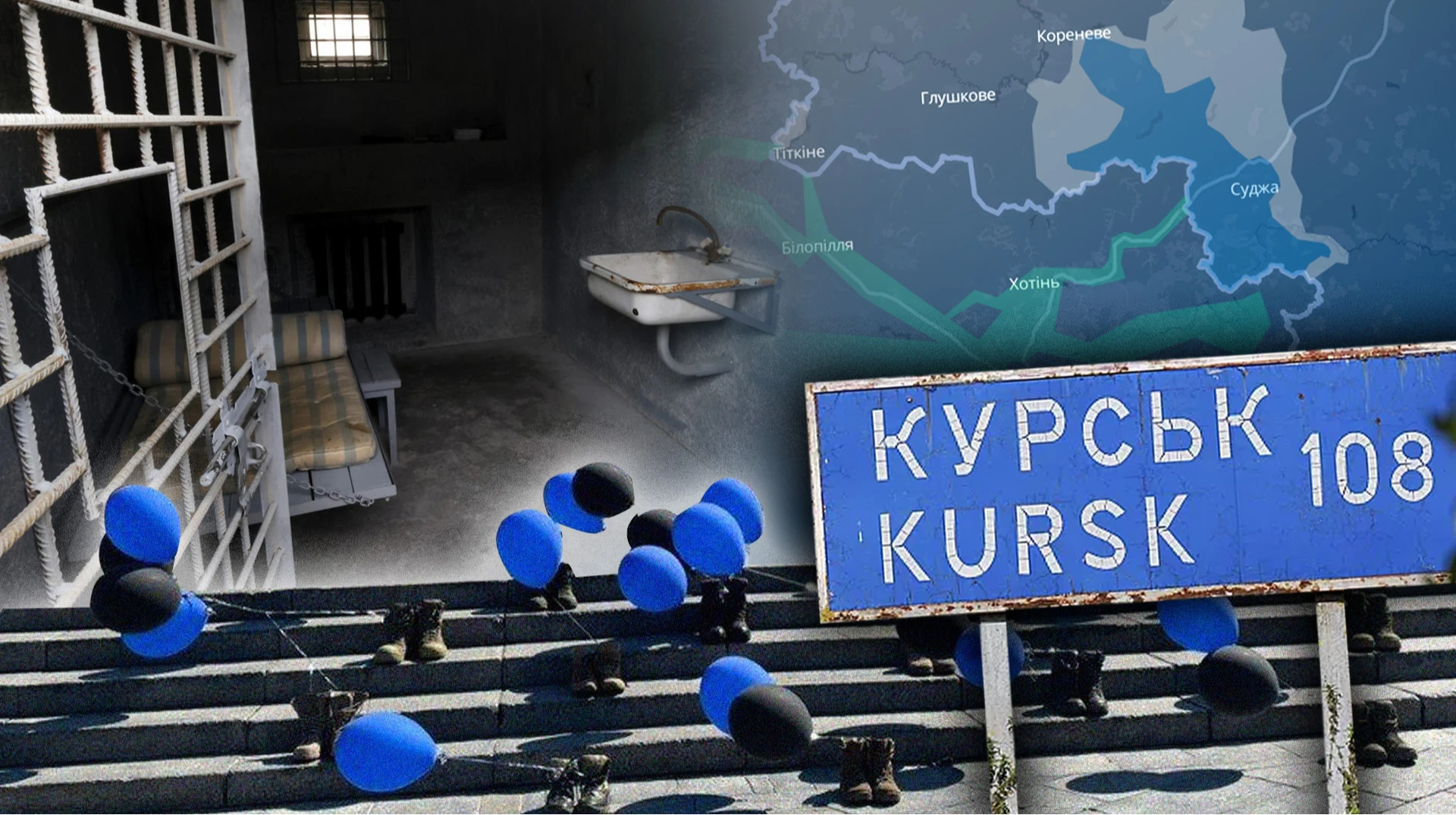
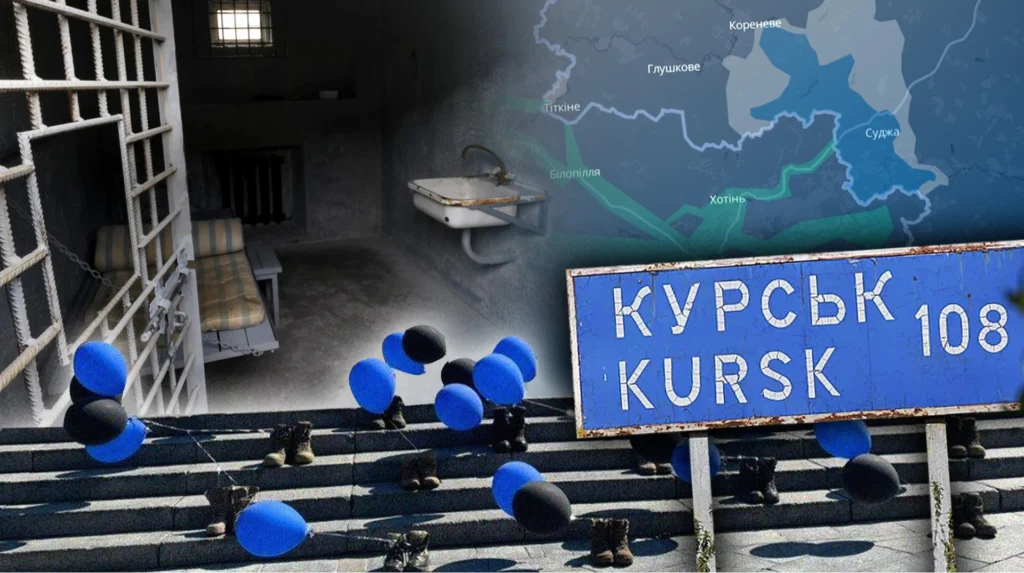
Blue and black balloons sway in the wind. Each is tied to a military boot. Fourteen pairs of combat boots are arranged on the steps of Kyiv’s Independence Square.
It is 29 August 2025. The temperature reaches 28°C, and one after another the black balloons, heated by the sun, burst. Only the blue ones remain — a symbol of peace and hope.
This was one of the first public actions organised by the NGO “United by Kursk”. Held on Ukraine’s Day of Remembrance of the Defenders, the event featured relatives of missing servicemen reading aloud letters they had nowhere to send because they were addressed to loved ones who had disappeared without a trace.
Few passersby stopped to listen that day. Attendance at the organisation’s other events has also remained modest. Yet Marina Okrainets, head of the NGO, does not interpret this as indifference specifically toward those captured, killed, or missing in the Kursk region. Rather, she believes it reflects society’s broader lack of attention to military families.
Before the full-scale invasion, Marina’s husband, Serhii, made custom furniture. In March 2022, he joined the Territorial Defence Forces. He defended Ukraine’s Sumy region and later fought near Kupiansk. In October 2024, he went missing in the Kursk direction.
For one year and two months, Marina tried to find out whether he had been captured. She held on to hope because no one had seen his body, and the fate of the two comrades who had been with him that day also remained unknown.
One of the first things she discovered during her search was that Serhii had been temporarily attached to another brigade, making the search significantly more difficult. In his home unit, Marina knew many soldiers and their families; in the new brigade, she knew no one.
While searching for her husband, Marina met other families whose loved ones had disappeared in the Kursk region. They eventually decided to establish an organisation, believing that collective efforts would be more effective and more likely to ensure that their voices were heard. From then on, Marina sought not only information about her husband but also about every Ukrainian defender who had gone missing in the Kursk region.
One day, her personal search came to an end. She received a phone call informing her that Serhii’s body had been found. His identity was confirmed through DNA testing, and a second examination verified the match.
Marina remained with the organisation.
“How could I leave when I already feel like part of one big family?”
One of “United by Kursk’s” activities is supporting the families of servicemen who returned home “on the shield.” But its primary mission remains searching for the missing.
“We constantly submit requests through state institutions regarding our defenders, trying to determine where they are being held or whether they are even in captivity. We ask the Ombudsman to send inquiries to the aggressor state. After every meeting, we make every effort to ensure our lists are forwarded and that prisoners’ captivity is officially confirmed.
If someone is missing, we contact investigators, submit written requests, and ask whether, God forbid, there is confirmation of death. Some of the men have already been sentenced. We try to locate them inside the aggressor state and establish exactly where they are being held so they can make a phone call, because convicted prisoners have the right to speak with their families. It is painstaking work every single day, every single month.”
But official requests do not guarantee answers, and searches do not guarantee results. Russia may refuse to acknowledge holding a particular serviceman. No one knows how many Ukrainian captives remain incommunicado — cut off from any contact with the outside world.
***
The information vacuum is a painful reality for many families who lose contact with loved ones during the war. In many cases, Ukraine learns the fate of a serviceman only after another prisoner exchange. Soldiers returning from Russian captivity often become the most important source of information about those who remain imprisoned.
For the “Kursk families”, however, the situation is different.
After sentencing, Russia keeps their relatives separated from other Ukrainian prisoners of war and rarely includes servicemen captured in the Kursk region in prisoner exchanges. As a result, even after a verdict has been delivered, the fate of these defenders often remains unknown.
The only thing Oksana has managed to learn about her son, Mykola, is that he was transferred to the Vladimir Central Prison to serve his sentence. Since then, she has received no word from him.
“You live in constant waiting. It’s incredibly hard, both emotionally and physically. Your thoughts are always with them. All that’s left is to pray,” she says. “You pray to God: if he’s cold, let Him warm him; if he’s hungry, let Him feed him. And may He keep our loved ones in His embrace, wherever they may be.”
Read next
Workshop for lawyers: trauma-informed legal practice when working with adult survivors of CRSV
On September 14, the European Human Rights Advocacy Centre (EHRAC) and ULAG held a joint workshop for lawyers working with adult survivors of conflict-related sexual violence (CRSV).
Articles
The voices of Ukrainians must be heard
The letter was published in May 2026 on the website of our long-time partner ECCHR, in the Living Open Archive section. It is a collection of personal impressions and stories from ECCHR staff and partners about the projects they work on, the injustices and contexts they experience, and the world they envision. They share intimate reflections in letters to their colleagues, allies, and the world.
Articles
ECtHR Case Law on the Consequences of the Armed Conflict in Ukraine: The Detention of Ukrainian Troops at the Chornobyl Nuclear Power Plant
At the start of Russia’s full-scale invasion, one of the primary objectives of the Russian armed forces was to seize control of the Chornobyl Nuclear Power Plant (ChNPP). In February 2022, Russian troops occupied the facility and detained everyone there, including both civilian personnel responsible for maintaining the operation of the plant and members of the National Guard of Ukraine (NGU), who were responsible for the facility’s security.