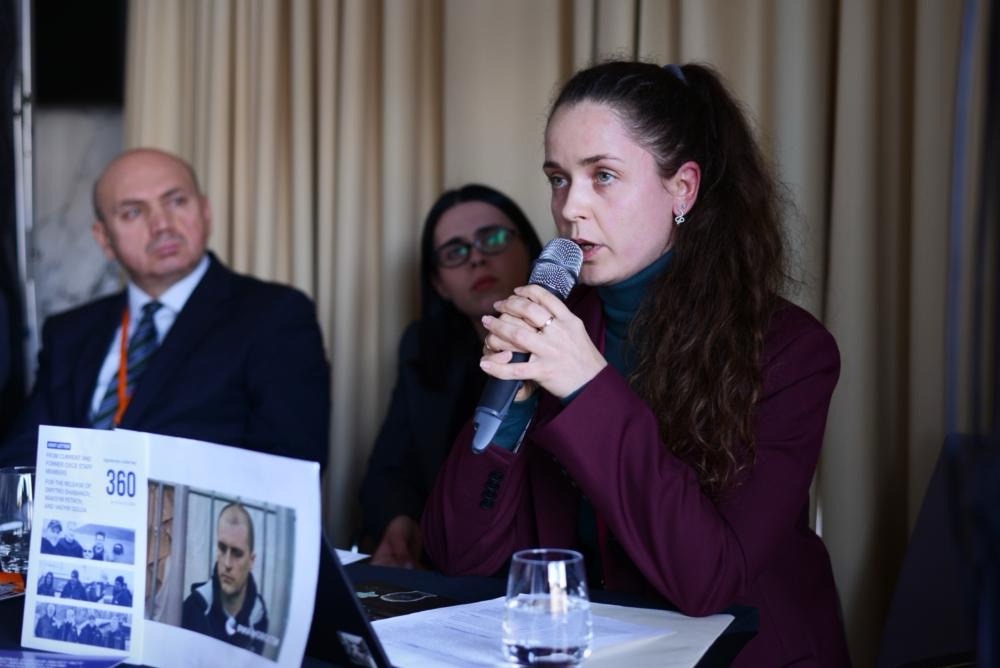
The suffering and violations that Dmytro, Maksym, and Vadym were subjected to reflect the issues WHDC and the OSCE in general are expected to combat, both in context of their individual case, but also as a systemic practice of international crimes committed by Russia.
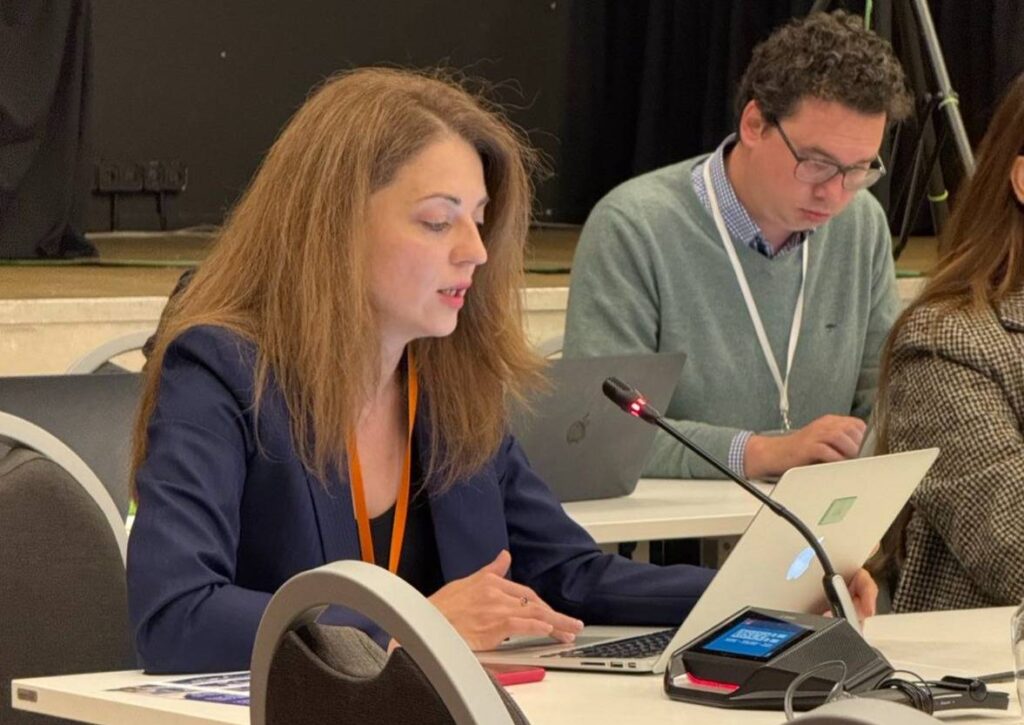
Margaryta spoke at the side event on Systematic denial of fair trial rights in Russia’s war against Ukraine organised by the Human Rights Centre ZMINA and Media Initiative for Human Rights with the support of the Czech Delegation to the OSCE, Human Rights House Foundation, and the Netherlands Helsinki Committee.
She stressed that the trial against her husband and his colleague was without legal merits, while the court proceedings were televised and later covered by Russian TV channels. They were sentenced for just doing their job in accordance with the mandate of the OSCE. In 2025 Dmytro’s and Maksym’s sentences were aligned with Russian legislation, and they were later deported to far regions of Russia – Chelyabinsk and Omsk.
“I know from witnesses who were detained in the same cells during the trial period in Luhansk region, that my husband was tortured during the interrogations until he lost consciousness several times, and was subjected to extreme psychological pressure, in inhumane conditions with lack of proper medical treatment.” – Margaryta noted.
During one of the Plenary sessions, Ievgeniia took the floor, addressing that despite their immunities, three OSCE staff members were held incommunicado, subjected to torture, forced into false confessions, and sentenced to 13 and 14 years in prison on fabricated charges under sham legislation of so-called “LPR”.
Margaryta and Ievgeniia held several bilateral meetings with OSCE Delegations of Norway, Ireland, France, Canada, Finland, Switzerland, Italy, Vatican, Poland, and the EU (some organised with support of Human Rights Center ZMINA).
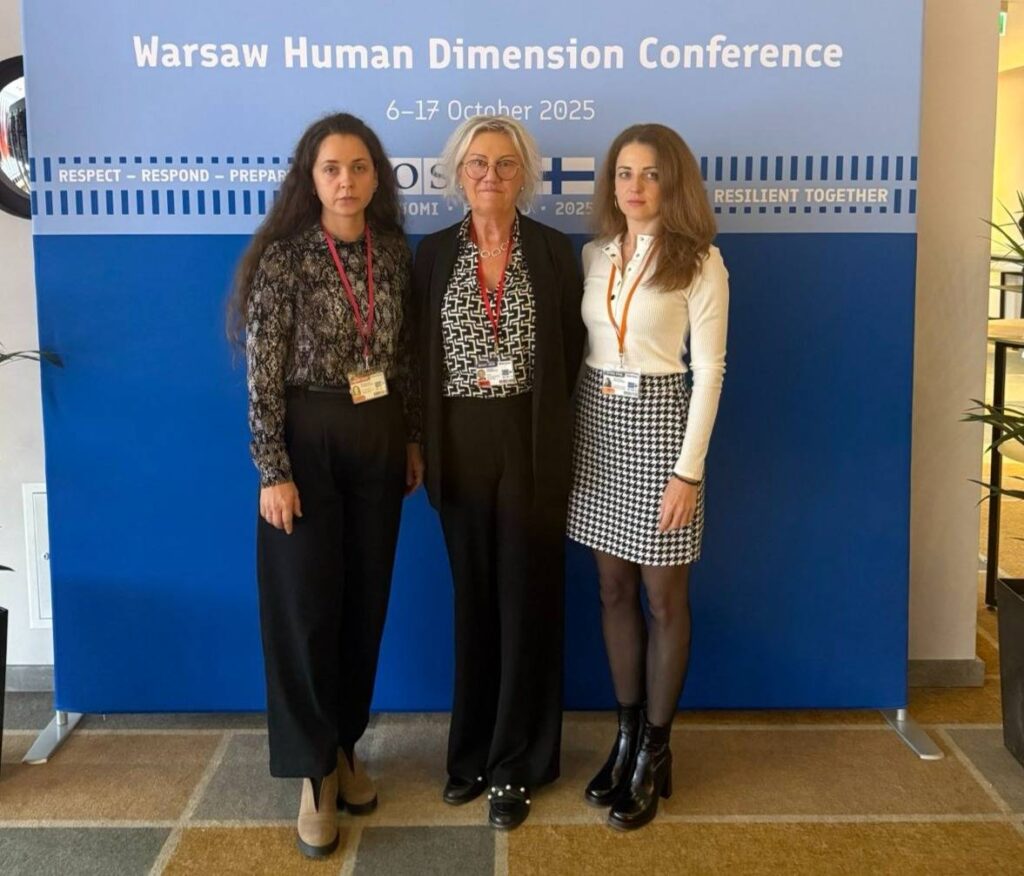
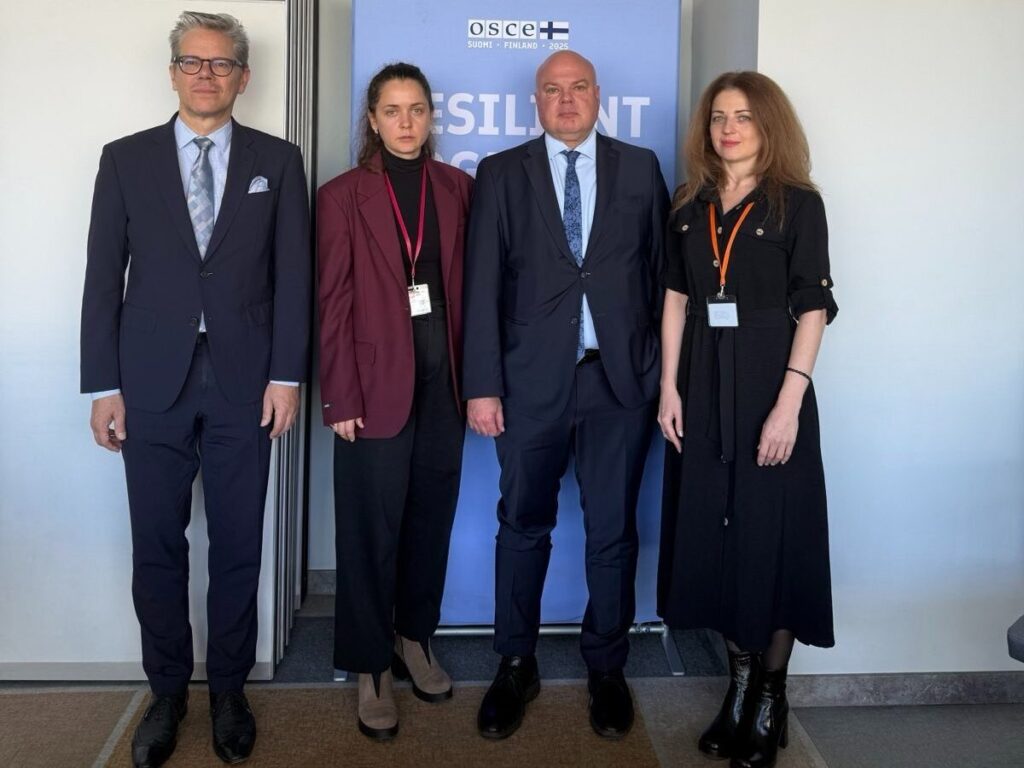
We also had an opportunity to meet with the OSCE Parliamentary Assembly President, Mr. Pere Joan Pons, who was elected earlier this year. During October’s visit to Ukraine, Mr. Pons reiterated the demand for the release of the OSCE staff members in his address to Verkhovna Rada, and the meeting with President Zelenskyy addressed the release of POWs and civilians.
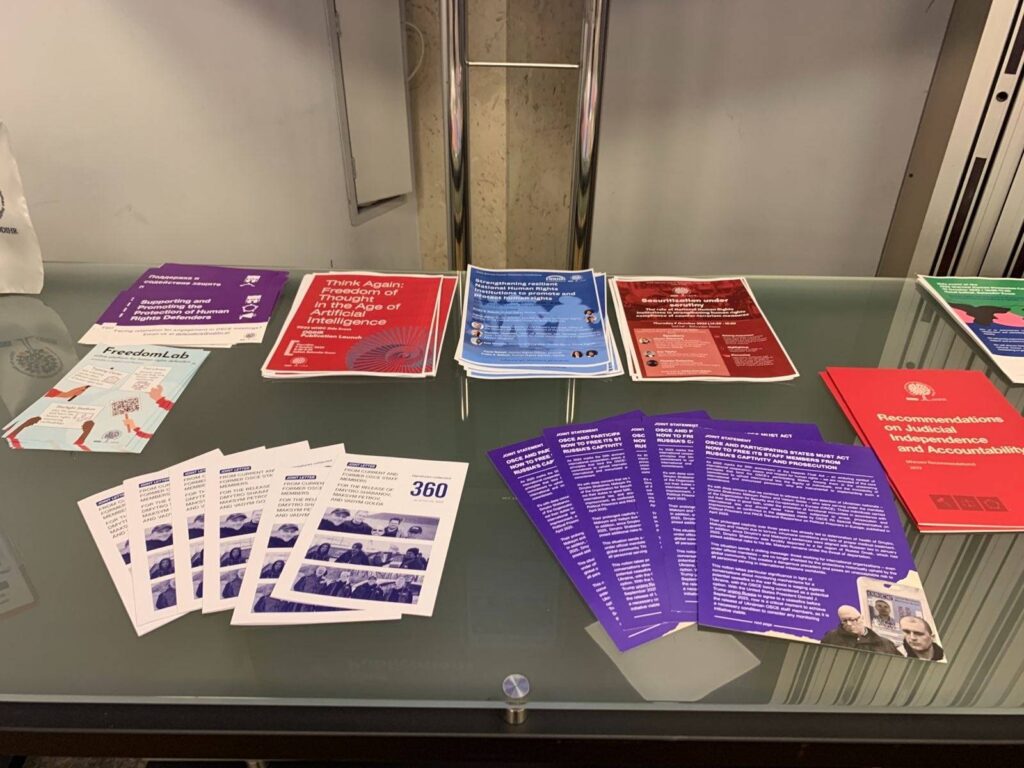
In August 2025, ULAG launched an OSCE Current and Former Staff Members’ Joint Letter For the Release of Dmytro Shabanov, Maksym Petrov, and Vadym Golda. As of October 17th, 361 persons have signed the letter, demanding firm action from the OSCE, an organisation whose values, goals, and principles they have supported with great effort and often at great personal risk.
The case of the unlawfully detained Ukrainian OSCE staff members is well known and has been raised at multiple levels, including during the OSCE Secretary General’s meeting with Russian officials. Public expressions of support – particularly from states and international organisations – demonstrate that Russia’s actions toward Dmytro, Maksym, and Vadym are being closely watched. Growing international pressure for their release offers hope that those in a position to bring about change will act.
We deeply appreciate the support voiced by participating States (including the Chairpersonship Troika – Malta, Finland and Switzerland), OSCE staff members, the OSCE PA President, and civil society, and hope for this collective effort to continue to strengthen.
In their remarks Margaryta and Ievgeniia called for such statements to be accompanied by concrete actions at all necessary levels.
Beyond the news about the OSCE Secretary General’s meeting with Russian representatives in March 2025, and occasional mentioning of the issue in meetings with Ukrainian officials, it is unclear whether there is an actual negotiation or other efforts being made to secure the release of Dmytro, Maksym and Vadym.
While it is understandable that not all processes can be made public, the families deserve to be informed and meaningfully engaged. The absence of information on the progress or actions taken – both by Ukraine and the OSCE – only deepens their sense of despair and disbelief.
“We need more than sympathy – We need resolve. We need the kind of courage that matches the dedication my husband and his colleagues showed in the OSCE field mission. Their lives matter and freedom matters. And time is not on our side.” – Margaryta stated during the side event.
As Ievgeniia stated at the plenary meeting, if its staff cannot be protected, no OSCE mission can be deemed safe or legitimate. In particular, national OSCE staff, vital to missions, are uniquely vulnerable in conflict zones – they remain on the ground during escalations and face retaliation from occupying forces. Freeing them is therefore imperative for the viability of any ceasefire or peace agreement monitoring, particularly in the context of Russia’s war against Ukraine.
The release of Dmytro, Maksym, and Vadym must be pursued through proactive and coordinated efforts, rather than sidelined by uncertainty over who bears ultimate responsibility for their fate.
Ukraine, the OSCE, and other participating States must work together and exchange information in order to find viable avenues for their release, including bilateral humanitarian negotiations with Russia, and engagement with states who can act as intermediaries.
To that end we also call for the establishment of an informal coordination group within the OSCE that would include OSCE officials, Ukraine’s and other state’s representatives, as well as family members.
Through Margaryta’s and other families’ perseverance and support from different actors, we are starting to see change. Now it must manifest itself into the result the detainees and their relatives have been longing for for more than 3 years – the release of Dmytro, Maksym and Vadym.
Read next
Articles
The voices of Ukrainians must be heard
The letter was published in May 2026 on the website of our long-time partner ECCHR, in the Living Open Archive section. It is a collection of personal impressions and stories from ECCHR staff and partners about the projects they work on, the injustices and contexts they experience, and the world they envision. They share intimate reflections in letters to their colleagues, allies, and the world.
Articles
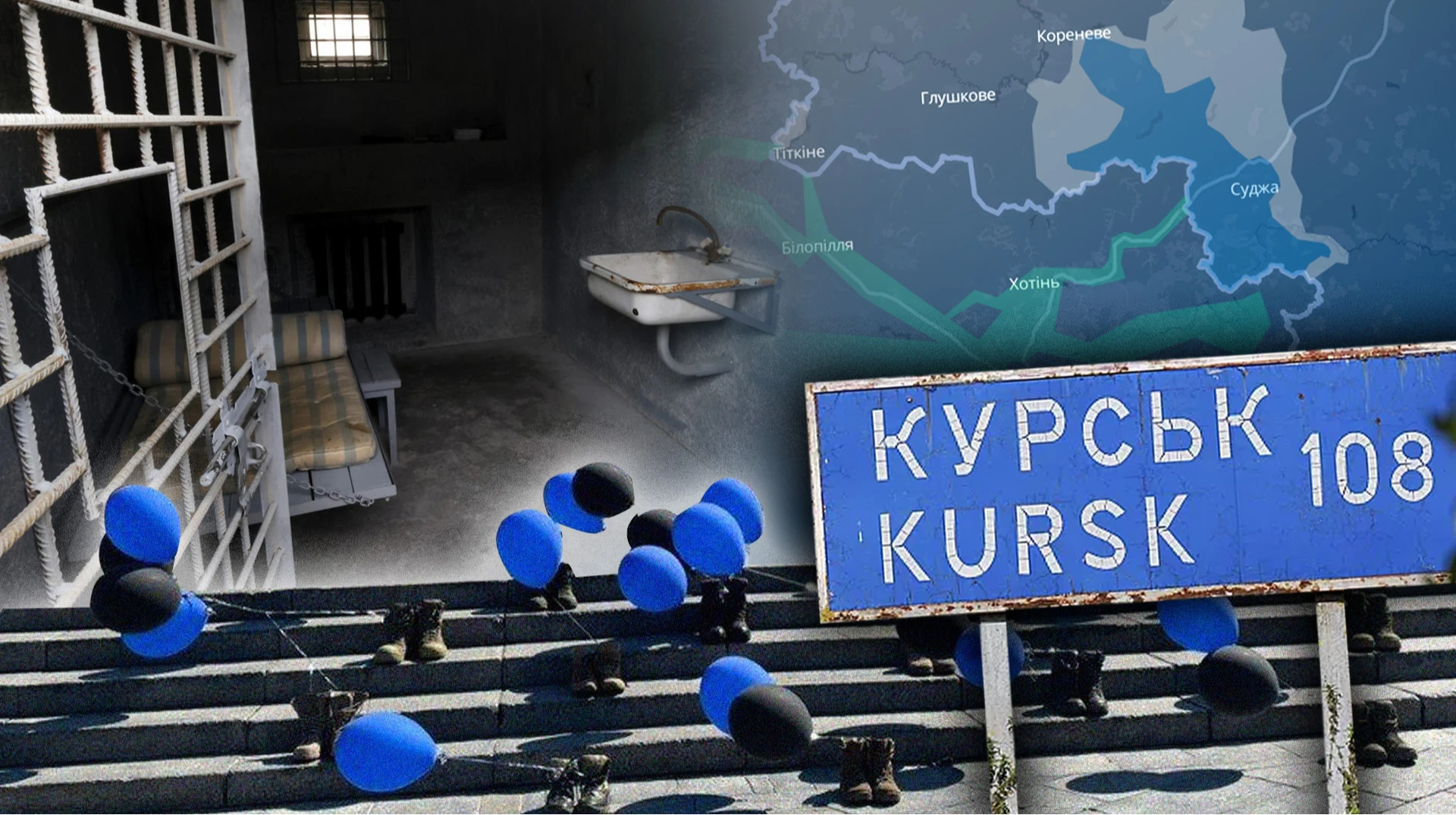
Prisoners of War Tried as Terrorists: What Is Happening to Ukrainian Soldiers Captured in Russia’s Kursk Region
The number of Ukrainians captured by Russian forces in the Kursk region remains hidden by the fog of war and defenders may be considered missing in action for months before suddenly appearing in photographs posted on Telegram channels alongside other prisoners of war. Or, conversely, families may search those same channels every day for any trace of their loved one, only to one day receive the devastating news of their death.
Articles
ECtHR Case Law on the Consequences of the Armed Conflict in Ukraine: The Detention of Ukrainian Troops at the Chornobyl Nuclear Power Plant
At the start of Russia’s full-scale invasion, one of the primary objectives of the Russian armed forces was to seize control of the Chornobyl Nuclear Power Plant (ChNPP). In February 2022, Russian troops occupied the facility and detained everyone there, including both civilian personnel responsible for maintaining the operation of the plant and members of the National Guard of Ukraine (NGU), who were responsible for the facility’s security.